Tuesday, March 22, 2011

Education Days 2011

Don’t miss our upcoming and exciting Education Days 2011! Pamela Kostur of Parallax Communications will be with us to lead an exploration of modular content design and reuse. Fernando Santiago MBA PMP CSM, with 20+ years of project management experience and certified Scrum Master Certification, will share his perspective on how to integrate and adapt Agile project management practices to documentation requirements.

Modular content design approaches break content into a larger volume of smaller reusable information units supported by storage, meta-data and relationship management techniques. Regardless the project management approach or size of an organization, content-reuse generally reduces content duplication and increases accuracy and consistency across libraries while enabling dynamic and flexible development of multiple deliverables from content sub-units.

Agile project management practices increase the number of completed prototypes along an iterative development path. These practices are also characterized by increased stakeholder and client engagement so as to increase likelihood of customer acceptance of the final product. Documentation practices can be partially or fully adapted to the Agile model. Learning the key concepts and gaining practical experience can help you minimize common project risks: excess production overhead, discarded prototype work, and tight deadlines. By leveraging the gains of this approach and being part of the critical project path, you will achieve improved requirements, status reporting, teamwork and communication.

Both modular content design and Agile practices, have gained recognition in recent years and are quickly becoming standard practice.

Learn the terminology, concepts and practices of each process now and become a documentation leader capable of managing the critical documentation project path.

Register now! For more information, see the Education Days micro-site.

Agile approaches to documentation requirements

This one-day introductory training course will provide you with a solid understanding of the core knowledge, terminology and concepts that define the Agile project management approach. A comparison of various project approaches highlights the key differentiators of Agile methods, and the implications within product development environments on communications, documentation and other related processes.

Hands-on exercises done in small groups provide practical preparation for applying the communication methods and concepts with a combination of basic tools, including Excel. You will become comfortable defining user-stories, as well as creating and sizing a project work item backlog. You will become confident defining "Done!" in the context of your project, be able to articulate project work velocity, plan work iterations, and generate tasks from backlogs and communicate the status of iterations using accumulated data. By the end of the course, you will be able to establish scrum procedures, a project backlog, a burndown chart, and have practical experience executing basic project iterations.

This course is intended for beginners or those with some previous knowledge or experience with Agile practices.


Writing modular reusable content

Modular content design approaches break content into a larger volume of smaller reusable information units requiring storage, meta-data and relationship management techniques. Regardless of the project management approach or size of an organization, content-reuse generally reduces content duplication and increases accuracy and consistency across libraries while enabling dynamic and flexible development of multiple deliverables from content sub-units.

In this course you will learn the key terminology and concepts related to modular documentation design. You will then learn how to analyze content, plan and structure content deliverables and the reusable content modules that will be required to satisfy the independent and collective deliverable requirements. Lastly, you will learn how to apply structure to the writing within the modules to maximize the clarity, accuracy and consistency of the module content which can be integrated with and used alongside writing guidelines.

This course is suitable for technical communicators with varying amounts of experience, from novice to well-seasoned.


Gwyneth Evans

Public Relations Manager

Tuesday, March 8, 2011

2011 STC Director Candidates

To be eligible for voting, you need to renew your membership by February 28. Voting starts on March 9 and ends March 30.

For full election details: http://notebook.stc.org/election

Bernard Aschwanden

http://notebook.stc.org/election/bernard-aschwanden


Member Status: Senior Member

Current Community: STC Toronto

Current Professional Title: President of Publishing Smarter

Company: Publishing Smarter

Company Location (City, State, or Country): Canada

Ray Gallon

http://notebook.stc.org/election/ray-gallon


Member Status: Senior Member

Current Community: France Chapter

Current Professional Title: Global Software

Technical Information Systems Designer

Company: Carestream Dental, division of Carestream Health Inc.

Company Location (City, State, or Country): Marne La Vallée (Paris region), France
(HQ in Atlanta, GA)

Brian J. Lindgren

http://notebook.stc.org/election/brian-lindgren


Member Status: Associate Fellow

Current Community: South Carolina Midlands Chapter

Current Professional Title: Systems Analyst

Company: Imagine One Technology & Management Ltd.

Company Location (City, State, or Country): Charleston, SC (HQ in Colonial Beach, VA)

Rich Maggiani

http://notebook.stc.org/election/rich-maggiani


Member Status: Fellow

Current Community: Vermont

Current Professional Title: Communication Consultant

Company: Solari Communication

Company Location (City, State, or Country): Essex, VT

Tricia Spayer

http://notebook.stc.org/election/tricia-spayer


Member Status: Senior Member

Current Community: Northeast Ohio, all SIGs

Current Professional Title: Technical Writer/Illustrator

Company: Pressco Technology Inc.

Company Location (City, State, or Country): Solon, OH

Thursday, March 3, 2011

Recording of STC Vice President Candidate Discussion

Sarah O’Keefe and Scriptorium recently held a webinar discussion with the two candidates for STC Vice President, Alan Houser and Victoria Koster-Lenhardt. If you missed the live webcast, watch this recording to get to know the candidates.


Thanks again to Sarah for hosting. Remember, the STC election opens 9 March and runs through 30 March at 4:00 PM EDT (GMT-4). You must have renewed your STC membership by 28 February in order to vote in this election. To learn more about all candidates and ask questions of the candidates, visit the STC Election site.
 
Republished from STC's Notebook Feed

Saturday, February 19, 2011

Summary of the Winter Council Meetings for Southwestern Ontario

Thanks to the power of technology, council continues to meet monthly. Did you know our council members live throughout Ontario, from North Bay, to London; Paris to Toronto; Guelph to Waterloo? We alternate our meetings from virtual to in person; some people dial in monthly. Our newest volunteer, Sylvia Squair, is our new liaison in London with University of Western Ontario and Fanshaw College. Our winter has been busy with event planning topping the monthly agendas:


Education days:

We’re still finalizing instructors for our Education days this spring. We are working on the same profit sharing model we established last year. We bandied about a number of topics and finally narrowed it down to content reuse and working with agile development.

Monthly events:

We are continuing to plan for a Webinar in the months we do not have an education evening. However, we did cancel February due to lack of interest.

Awards night:

Our annual Awards night is scheduled for March 30 at the Davis Centre. We’ll be presenting the Heidi Thiessen Memorial scholarship, Publication Competition awards, Summit award (drawing will take place that night) and Distinguished Chapter Service Award. Fei Min is looking into bringing the STC Travelling Road Show to the event. The road show showcases the International Competition winners from last year.

Annual General Meeting:

In June, we’ll have our Annual General Meeting and are looking for a speaker.

Other items of interest:

• Student competition is underway. We posted notices in London, Toronto, Waterloo and Guelph. Judging will begin shortly.

• Technical publications judging was completed in conjunction with the Toronto chapter, in one day. One entry in the group will go on to the International competition. Nancy will arrange to have the certificates for our chapter winners ready for the awards night.

• We finalized and rolled out the participation game. See our website for the current leaders.

• We’ve purchased an early bird registration to the Summit (transferable) that will be awarded to one volunteer at the Awards night. The person selected is expected to attend the Leadership day, write an article on the Summit and present a seminar on their learnings.

• We discussed the best way to communicate to members and decided to use a variety of options so people can pick the one that best suits them. With that in mind, we’ve set up Linked-in and Twitter accounts.

• The STC launched their new website. In future we will be able to set up a micro-site on the site. At that point, we’ll investigate how best to tap into this.

• Communitech representatives have attended some council meetings. Avvey Peters is our new Communitech liaison.

• As of year end (2010) our chapter membership is at 73 people.

• The audit has been completed on our 2010 financial statement.

• We’re pursuing sponsorship options with Front Runner.

• STC elections are coming soon. We’ll provide election information on the Blog and website. There are several international candidates including Canada’s Bernard Aschwanden running this year.

• And last but not least, our February council meeting was completed in a record breaking sixty one minutes!

Carol Lawless
Secretary
Southwestern Ontario Chapter STC

Thursday, February 10, 2011

STC’s International Candidates

My fourteen years of STC membership have undoubtedly provided excellent professional development value, from a local perspective.

Initially, I relied on STC for contacts in my neighborhood to help me become established in the profession. As I grew in confidence and experience, I joined my chapter executive and tried to pay it forward by helping to provide a platform for new tech writers, as others had done for me.

The work is rewarding, and my colleagues on our chapter executive are first-class. So I guess you could say, I love the STC.

But at the international level, I have certainly felt some frustration. A particular sore spot for me is the way this international organization seems to remain firmly focused on what happens within the United States.

In 2010, I joined first the Community Funding and Support Task Force, and then the Community Affairs Committee, to help define the kinds and quantities of support that would most benefit our chapters and SIGs. My particular interest was the full inclusion of international members.

I participated out of concern that STC membership fees purported to provide a number of benefits that weren’t practical (US-centric job bank and salary data) or weren’t available (insurance) to international members. During our sessions, I learned that even within the US, rules vary so much from state to state that things are not substantially better for Americans!

At the Dallas conference in 2010, the Community Funding and Support Task Force summarized a number of recommendations. Many of these ideas are now being put into practice, and I hope they will benefit all STC members.

I believe that the STC executive genuinely desire to improve the value of STC memberships for all members, but change is always hard. Even characterizing myself as an “international” member suggests that “American” is the default position – exactly the perception I am struggling against.

But my experience on these committees has helped me see that the STC needs leadership from its international members, before it can become the organization it is striving to be.

In the upcoming STC election, we have a chance to vote for two international candidates. Bernard Aschwanden (Canada) and Ray Gallon (France) are both running for election as Directors of our Society.

I believe that the fresh perspectives these experienced members bring can help the STC transform itself into a truly international organization.

So when you vote for your new Society Officers between March 9 and March 30 this year, ask yourself whether the STC could use a helping hand from some international candidates.

And if you agree, then remember: Bernard and Ray are willing to step up and help us all.

Thank you,
Tracey Martinsen


Tracey Martinsen has been a member of the STC (Canada West Coast) since 1997.

Friday, January 21, 2011

Education Evening: Arbortext Service Information Solution

By Kaitlin Ojamae

If you’re using Adobe® Technical Communication Suite for your documentation projects – or perhaps grinding away with the Microsoft Office® suite like I am – prepare to be impressed by the Arbortext Service Information System.

An hour was not enough time for our presenters, Richard Ernst and Anthony Villa, to showcase all the tools and functionalities of this system. In fact, two hours were not enough to do it justice! The information-rich presentation was punctuated by our members’ sighs of, “Oh that’s wonderful,” and “Oh, that would make things so much easier!”

Overview of the Arbortext Service Information System

Anthony Villa, President of Newbook, credits the success of Arbortext to the manner in which all the components are connected in a fully integrated system; the product and all its information is centralized in one place, so users avoid delays most commonly caused by the inability to locate up-to-date information.

“If it’s not connected back to the product data, you lose the connection to the product data itself,” Villa explains.

As technical communicators, we are all familiar with the frustrations of lost requirements and valuable time wasted by information hunting. As an all-in-one solution, Arbotext allows you to “go to the source” of the product itself. For example, if you need information fast, simply do a query and get a list of information – you can then decide what format you want the information in. It is all associated with the content, which drives efficiencies, like a feedback system.

Villa admits that the system is “not perfect,” but it connects people with the data, and the data with the products.

The Integrated Tools

We were fortunate to get a demonstration, from Training Coordinator Richard Ernst, of the five tools that comprise the system. Ernst went through the stages of a typical documentation project, to showcase the system and how it encompasses all the phases of documentation (authoring, illustrating, revising and updating, styling, collaborating and reviewing, publishing).

The Arbortext Editor allows you to create content, edit and collaborate globally. The interface allows you to integrate text and illustrations, DITA maps and concepts. In fact, the system is designed to work with DITA. You can insert mark-ups and view tags – it even has a handy quick tag menu to make authoring more efficient. You can copy and paste from anything, including the web, PDF, Word, etc. When creating DITA maps, you can either layout the structure of the document or assemble the topics into a structure (working up or working down).

Revision and change management is easy – everything uses an associative link, so when you change a topic or illustration in any document (or tool), all files containing the same topic or illustration can also be updated automatically (if you want them to).

When you close the application, it retains your preferences of how you like to work (e.g.: with tags visible) for the next time you open it. These are just a few of the features that make the Arbortext Editor more intelligent than the average editor.

The Arbortext IsoDraw is CAD neutral and standard for technical illustration. You can work in 2D or 3D, in perspective or go to plane view; you can even work with legacy drawings and draw on the existing perspective planes. IsoDraw supports any export file type (even ones you haven’t seen since 1996). Your 3D CAD models can be made to match the grid and repurposed for different audiences and documents. Animations can also be made from existing 3D CAD models and played within the Arbortext Editor (there were many OOOs and AHHs at this point in the demonstration).

Another feature to give your illustrations an artistic flair – IsoDraw maintains thick and thin pen strokes in legacy drawings, even as you edit them.

The Arbortext Styler allows you to define many different stylesheets to apply to your content. Using these dynamic stylesheets, you can ensure that the information published is consistent across all media types. If you choose, you can create a master stylesheet to apply to multiple channels or enable multiple delivery formats (web, print, PDF, Word, HTML Help). You can also apply style rules from DITA or other standards.

The Arbortext Publishing Engine can take the same content and publish it to multiple outputs such as the web, PDF, Word, DVD, CD-ROM, and HTML Help. Using the engine, you can choose from multiple document layouts such as two-column or single column, fold-out page formats, or automatic styling. Of course, front and back matter can be automatically generated, including tables of contents, list of figures, and indexes.

Arbortext also has a Content Manager, although it is not required in order to use the tools and get most of their benefit.

For more information on the Arbortext Service Information System (because you know that this single blog article barely scratches the surface of what this robust system can do), check out Newbook’s website.

Wednesday, December 15, 2010

7 Simple Steps to DITA

By Lori Jamieson

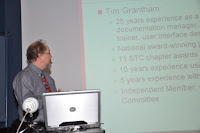
At our November meeting, Tim Grantham from Front Runner Training offered a practical training session on what might be considered herding ducks – making documents line up nicely into a row so they can be moved into and managed in DITA.

In his “7 Simple Steps to DITA” talk, Tim acknowledged that simple rarely means easy, but encouraged us to cling to the goal of using DITA to achieve productivity gains. “There’s a lot of wasted energy in managing conventional documents,” Tim says. That includes manually reformatting translated documents, manually copying and pasting content from one document to another, manually updating copies of content in multiple documents and manually converting documents from one proprietary format to another.

So what’s Tim’s recommended starting point? “Identify a common document type. Really dig in to find the documents that belong together... the shorter and more commonly used the better. His next steps?

Step 2 – Identify the structural elements common to most instances of the document type. For a product brochure, this might be title, product, value proposition, features and benefits, contact information.

Step 3 – Identify common content.

Step 4 – Identify unique content. Example: product name will be different from one brochure to the next.

Step 5 - Define a form or content template for each document type.

Define variables/ properties for fragments of content that occur frequently within an instance of the document type.

Step 6: Once you have standardized structure, then standardize content. Find chunks of content that are the same everywhere they are used.

Step 7: Standardize formatting. Keep paragraph, character, table styles as simple as possible.

Other hints for beginners: Use only defined styles. Define the number of text styles that you really need and resist every urge to start customizing. Define styles for structural elements – titles, images, terms, cross-references.

Tim’s recommendations for additional investigation: DITA Open Toolkit, a software add-on that can apply formatting to content. Tim says it is fast and reliable but that customizing the default formats is complicated for non-technical users. He also recommends Introduction to DITA, a new book by JoAnn Hackos.