

 Posts
Posts


By Carrie Warner
I’m really glad I attended this year’s Southwestern Ontario chapter STC Awards night event at McCabe’s in Kitchener. It’s the first awards event I’ve attended in quite some time. As a senior member of the chapter, I don’t manage to attend all of the chapter events anymore – sometimes because of existing household schedules and pre-existing commitments, and sometimes because the events just aren’t terribly relevant to my career or my job in the moment. But I’m really glad I went last week to this year’s event, and I’m going to tell you three reasons why the event was so special for me.
When I arrived, I encountered a new friendly face – and that was worth the price of admission right there. After being a technical communicator in Waterloo Region for more than 15 years, meeting someone new can feel like a bit of a novelty. We technical writers are a close-knit community; it can feel like everyone knows everyone. I look forward to meeting fellow writers, trainers, illustrators, and instructional designers; I enjoy learning where they work, what industry and audiences they write for, and I love swapping and sharing workplace experiences. We do similar jobs, but each job is unique.
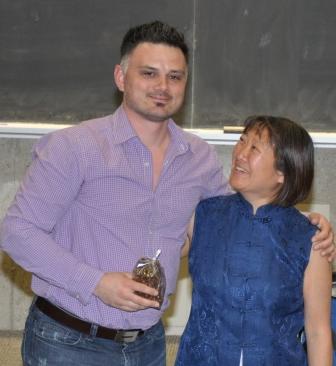
When the group settled down to study the delicious menu at McCabe’s, I was introduced to one of the evening’s award recipients. This was my second delight of the evening. This young man, beaming from ear to ear with pride, brought his parents to share in his success. They’d come a long distance to celebrate his well-earned award in technical communication excellence, and they couldn’t have looked more pleased. It warmed my heart to see how loved and supported he was, surrounded by his family, and it reminded me that the local STC chapter is, by its very nature, a family.
See, I have an amazing career and I love what I do for a living. I love it when people’s faces light up when I tell them what I do. It doesn’t occur to people that writing product documentation could be a rewarding, fulfilling, and engaging career. But it doesn’t take the skeptics long to understand that technical writers love taking complex information and making it accessible to everyone. We love it when someone exclaims aloud that a task or activity wasn’t nearly as hard as they thought it would be, thanks to the documentation! Many of us hear often that people don’t use what we produce, but I know it’s there if they ever do need it. After all, few things in life run smoothly all of the time, and occasionally, you’ll find yourself needing to troubleshoot to get back on track, whether it’s your refrigerator making funny noises in the night, or your internet browser closing suddenly with nothing but a cryptic error message popup in its wake.
When you love something as passionately as your own career, it’s important to find like-minded others who share that enthusiasm and nurture your spirit! That’s where my local STC chapter comes in, and that’s why I consider them family. I joined my local chapter in 1998, when I was in my final year of undergrad at the University of Waterloo in the English Rhetoric and Professional Writing co-op program. A wise professor told me that a well-suited professional society network was an excellent pack to run with – they’d help me grow and they’d give me the chance to give back. He couldn’t have been more right about that.
Attending the STC awards event last week was a little like going home, as sentimental as that sounds. I was active early in my career because our local STC chapter had much to teach me and I had so very much to learn. Later in my career, I took on senior, lone writer positions that kept me incredibly busy, and I didn’t make the time to attend events as often as I should have. However, as I found myself in mentoring and management positions, I learned how rewarding and enriching it can be to give back as I taught brand new technical writers the art and the craft as it was once taught to me. Being able to share my knowledge and experience with other writers is far more rewarding than I ever imagined possible.
As I sat at the dinner table, sharing anecdotes and experiences with my fellow writers and newly minted award winners last week, I was reminded of just how valuable and how welcoming my local STC chapter can be. We laughed at recreational period use in written documentation; we shared in the successes of some very talented young writers while encouraging them to write well and write often.
The third wonderful thing about the evening is how I grew a little bit that night amongst the laughter, the sharing, and the celebration. I was suddenly reminded that I’m far more than the sum of my experiences and education because of my own talented peers, mentors, coworkers, colleagues, and fellow STC members who offered me a bit of themselves throughout my career.
When I arrived home, the first thing I did was reach out to the current executive to ask how I could help. A senior technical writer has found her way home again and it’s time to give back where she can.
Monday, April 15, 2013


Awards Night 2013 - The Award Goes To....
The Awards Night that took place on March 28th meant different things to different people. The fact that it was a great opportunity to socialize and network was a given; however, as the name of the night implies, there were awards to be given to some very deserving people. As the invitation to the event indicated, none of the awards involved golden statues, but all of them were just as important.
The Summit Award
 |
| Kathryn Bender with Rob Cundari |
The Heidi Thiessen Memorial Award
Each year, we issue three awards to students for excellence in technical communication. This year's winners were Sandy Vazan of Sheridan College (1st Place); Raymond Alanguilan of UOIT (2nd Place); and Joel Thomson of the University of Waterloo (3rd Place). We awarded these students $1,000, $500, and $200 respectively, in addition to giving each winner a one-year student membership to the Society for Technical Communication.
To be eligible for this award, students had to provide proof that they were registered in an Ontario college or university for the 2012-2013 year, write a letter stating why they should win the award; produce an original piece of technical communication based on a list of possible topics, for example, "How to write an effective essay", "How to plan the perfect party", and "How to stretch your budget"; and submit a second piece of technical communication that they had produced for school. The original piece of work was a new requirement and it enabled students to show the more creative side of technical communication. Entries included drawings and illustrations, PowerPoint presentations, videos, brochures, essays, and posters. The entries certainly demonstrated that simplifying the complex can take many forms, which is something that we, as technical communicators, often try to convey to the people around us, whether they are employers, other people at work, or even our own families.
Just as the entries varied, so did the method of presentation to the winning students. Ray was able to attend in person with his proud parents by his side. Joel contacted us through Skype while he was in Boston on an internship. Sandy was unable to attend due to other commitments, but I was lucky enough to talk to her through Skype a few days later. For those students who could not attend in person, I can honestly say, "The cheque is in the mail."
 |
| Joel Thomson with Debbie Kerr via Skype |
 |
| Raymond Alanguilan with Debbie Kerr |
Distinguished Chapter Service Award (DCSA)
 |
| Fei Min Lorente with Robert Cundari |
From my perspective, I was grateful to attend the Awards night, socialize with a great group of people, and witness that sometimes people get the recognition that they truly deserve.
Thursday, March 7, 2013
DITA Doesn’t Mean Scary
By Fei Min Lorente

A group of local DITA enthusiasts met for the first time at
the Queen Street Commons Cafe, and found they had a lot to get excited about.
The message is that DITA (Darwin Information Typing Architecture) can be for
everybody: from small shops to big companies, from the President to the
technical communicator. Not that we’re at the bottom of the hierarchy—I mean that DITA can be useful
for anyone from the least professional writer to the most, because chances are
that the information has to be shared, stored, retrieved, and maybe (gasp) even
re-used.
If you are wondering what in the world I’m talking about, start with this primer from Publishing Smarter: www.publishingsmarter.com/resources/books-and-articles/dita-primer-learn-dita Or come to our next meeting and we’ll talk you through it.
Once you know the basics, you’ll realize that DITA is really just another tagging language, like HTML, but you have to follow the rules. No missing end tags! Following rules is a good thing: it makes sure everyone can share files, and no DITA interpreter will misinterpret what you mean.
Speaking of meaning, DITA makes you think in semantics, not
format. You tag something as a title, not 14-point Calibri bold centred,
and not even Heading Level 3. Free yourself from the drudgery of formatting!
Admittedly, the hardest part is thinking in topics, but in this age of mobile devices and web apps, we have to think beyond the book paradigm. Remember grammar school, where each paragraph was supposed to begin with a topic sentence? That’s really all topic-based writing is. In DITA, a topic can be complex enough to need several paragraphs, lists, and graphics, but it should be just what you need to describe the topic, and no more. If you can do this, the information you create is more useful because it’s reusable. You can still get a book in the end, but you can also have training material, specifications, test plans, marketing material, annual reports, and more.
Several DITA evangelists want to spread the word that DITA is not just for technical communicators: it can forge the path to enterprise-wide content management. Why waste time writing the same information in different ways? Why write it again just because you don’t know that someone else has already written it? With another powerful feature of DITA—metadata (information about the information)—you can create intelligent content that is easy to find when you need it, notifies stakeholders of changes, gets approved by the right people, and automatically disseminates updates to the right places.
Even the experts have more to discover, so they are looking forward to the next meeting. In the meantime, they’d like to leave you with a few links to explore:
- For more information about implementing DITA using Microsoft Office and SharePoint, see DITA Exchange (www.ditaexchange.com/Pages/Home.aspx)
- For people who can help you customize your DITA list of tags so you only see the ones that are relevant to your workplace, see Ditanauts (ditanauts.org)
- For a discussion group on LinkedIn, see the DITA Awareness Group
- If you want to join the local DITA Special Interest Group or attend future meetings, please contact Javed at dita@stc-soc.org
Wednesday, August 1, 2012
He’s a Teacher, Eric Walters at the AGM
By Fei Min Lorente

Eric Walters is a man on the move. After driving out to Waterloo to talk to us, he was scheduled to appear in Coburg the next day, and another Ontario town after that. He’s done book
tours all over Canada,
visiting towns as small as Prince
Rupert and as far away as White Horse.
Then there’s his research. He’s been to Japan, Kenya,
England, France, Haiti; wherever the story happened.
If there are tigers in the story, he gets up close and personal with live
tigers. If there are elephants and lions, he’ll go visit them, too. If the
story involves crossing a desert on foot, he’ll do that also (did you know that
the Tatooine scenes in Star Wars was shot in the desert of Tunisia?
Eric is a wealth of information).
He knows a vast array of fascinating people, some who are
“ordinary people” and some who do extraordinary things, like climb mountains
all over the world, or run marathons across Death Valley.
All of them have a story, and Eric wants to hear it.
Messages:
- Boys should read fiction as well as non-fiction to help their Emotional IQ.
- We should honour our war veterans; they are real heroes, not sports stars or celebrities.
- Being a father is his most important job.
- Girls should know that anyone who puts them in danger doesn’t really love them.
- Respect wildlife and the natural world around you.
- Finish what you start.
- Even if it costs more, support local businesses if their products are made ethically and the imported products were not.
- Don’t pay bribes, even if it takes longer and costs more.
- Look beyond people’s bad actions; there’s a reason for them—so go after the reason, not the people.
- A goat in Africa should cost an average of $40. If a charity is selling you a goat for a poor family for $100, you should ask them what they’re doing with the other $60.
Likes:
- Equal rights for women
- The Hunger Games
- Sushi
- Canada
- War veterans (real heroes)
- Free the Children and the Terry Fox Foundation
Dislikes:
- Racism
- The Twilight Saga
- Negative thinking
- People treating celebrities like heroes
- Child exploitation
- Charities with expensive offices and executives that make so much money they can afford to send their kids to private schools
Eric told us plenty of stories about where he got ideas for
his books and who became the characters in them, but there’s one story about
his orphanage in Kenya
that stood out. The orphanage didn’t have a well yet, and the water they’d been
collecting from rainfall had run out, so the orphans went to the closest
village, about 2 km away, to get some water from the trickle of a stream that
was there. However, the villagers told them they couldn’t have any water, and
if they came back, they would kill them. So until the rain fell again and their
well was finished, the charity had to buy and transport water to the orphanage
at great cost. This year, the charity is finishing a well for that nearby
village, and it is being given to them from the orphans. Eric knows that the
villagers are not evil; they were just protecting themselves and their families
as best they knew. So instead of treating them like the enemy, he’s turning
them into friends. If you want to hear more of his stories, you should buy his
books.
Yes, Eric Walters is a writer, but he’s also a great
teacher. We learned a lot, and the people who read his books, young adult or
old adult, will learn a lot, too.
For more information about Eric Walters, see http://www.ericwalters.net/. For more
information about the charity he has founded, see http://creationofhope.com/.
Sunday, July 29, 2012
2012 Annual General Meeting
By Carol Lawless
We wrapped up another great year, in June,
with our third annual general meeting. While the highlight was Eric Walter’s
inspiring presentation, we did manage to complete some business.
Last year’s minutes and our financial report
were both reviewed and passed. The STC is discussing changes to how they fund
chapters. Under the current funding model, our chapter has not received any
funding since 2009. However, Jim Bousquet, our treasurer, pointed out that we
have been able to draw on our fiscal reserves to pay for chapter events. The
chapter is slowly working towards a balanced budget, and we hope that a new
funding formula will help to bridge the gap between expenses and revenue.
 |
| Rob Cundari, President with Fei Min Lorente, Past President |
We held our Board of Director elections. Three
positions were available and all three were unanimously elected. Our former
vice-president, Rob Cundari steps into the President’s shoes, Fei Min Lorente
moves to Past President and Jim Bousquet continues in his role of Treasurer.
With Carol Lawless’ move to B.C., Debbie Kerr replaces her as Secretary.
 |
| Jim Bousquet, Treasurer with Fei Min Lorente |
 |
| Debbie Kerr, Secretary, with Fei Min Lorente |
 |
| Rob Cundari, President addresses the group |
- Community: We plan to improve our presence and involvement in the internal STC community and raise awareness about our chapter externally.
- Communications: We will improve communications not only to our members as well as our yet-to-be members within the technical writing community.
- Commitment: This group of volunteers is committed but we want to draw out more involvement with the rest of our membership.
- Celebration – We have some amazing accomplishments. We will celebrate and advertise them!
 |
| Carol Lawless receives the DCSA |
And speaking of celebration, The Distinguished
Chapter Service Award was officially awarded to Carol Lawless. She
was recognized at the April awards night but wasn’t in Ontario to receive the award.
Congratulations Carol and thank you for all your hard work and devil’s advocacy
over the years.
Fei Min also thanked the many other volunteers
who have made this year a success:
·
Sylvia Squair - Liaison to
universities and colleges
·
Nancy Halverson - Hospitality
and Competition Manager
·
Sian
Waterfield - Competition Assistant
·
Kathryn Bender - Programme Manager
·
Debbie Kerr - Student Awards
Manager, Past President
·
Jim Bousquet – Treasurer
·
Carol Lawless – Secretary and
Membership Manager
·
Rob Cundari – Vice President
·
Absent but still appreciated: Ursula McCloy, Ann
Garniss, Patrice Bernard, and Gareth Evans
·
A special thank you for all our
families for supporting us in our work. And a thank you for the members.
 |
| Sian Waterfield with Fei Min |
 |
| Nancy Halverson |
And finally, a huge thank
you to Fei Min for all the hard work she’s done over the last three years. Fei
Min has been a tremendous leader during a challenging time.
As President, she kept the council moving and the chapter running smoothly
during the STC financial crisis and subsequent transformation of the
organization. Thanks Fei Min, for getting it done! Fei Min summed up her tenure
as “the best of times, the worst of times”.
Through it all, our members have patiently supported
the many changes, trusting that they will eventually lead to a vibrant chapter
in this new social and professional climate.
Thursday, June 28, 2012
Determining Potential Career Paths
By Lynda Baxter

While technical writing has played a
significant role in their career paths, it has also been a springboard to
learning and getting involved in more specialized areas of user advocacy.
Here are my takeaways:
- Don’t be afraid to think outside the box. For example, you may have technical writing expertise that can morph into marketing or user experience roles.
- Be aware of possibilities not just to advance your career or move it in a new direction, but also to help your company solve problems or be more efficient.
- Be willing to develop new skills. For example, become proficient in HTML or at least understand how it works.
- Network and join or start! professional groups with like-minded people.
- Stimulate your thinking by reading and doing.
- Become a respected advocate for excellence within your company.
All in all I was very impressed with the
passion the panelists have for their jobs, their flexibility, and their
willingness to share their time and experience with others.
Follow them on Twitter:
@CathyDisbrow
@uxMark
@katewilhelm
@Kerr_Debbie
Friday, May 18, 2012
Transitioning from one role to another
By Scott Russell

On May 15, we enjoyed an engaging, interactive
session with Susan Malcolm, a career consultant at Laurier’s Career Development
Centre. Susan has helped hundreds of people with job search and application.
This was the second of a two-part meeting series on transitioning from one role
to another. On May 10, we hosted a panel discussion on determining potential
career paths.
Susan stressed the importance of researching the
job market and target companies before applying for a job. This research should
not be limited to Internet searches and sites such as GlassDoor.com, but
include social media (Twitter, LinkedIn) and informational interviews. Such interviews
are best conducted before a job opportunity arises, and the contacts can be
re-engaged when applying for a job.
When it comes to applying, Susan recommended
reading the job notice thoroughly and ensuring your cover letter and résumé
respond to all the requirements. She said companies scan résumés for keywords
to shortlist applicants for further consideration.
Susan said employers are now hiring for
transferable skills, such as flexibility, teamwork and leadership, and choosing
to develop new hires lacking in some technical skills. So it is worthwhile to
assess your transferable skills, track your progress in developing them, and
map your skills to job requirements.
We did an exercise to assess our transferable
skills. Susan distributed a seven page list of skills. She said successful
candidates align their cover letters, résumés and interview responses to ensure
employers know their transferable skills and how they can benefit the employer.
Of course, you have to know something about the employer to express these
benefits meaningfully.
Sometimes you may not have all the skills
required for a job. Susan recommended looking at what you have done and drawing
parallels to what is required for a job. For instance, you may not have managed
others, but may have led a sports team, taught a martial art, or managed a
volunteer event. Susan did caution that you shouldn’t bend the truth in your
application package as employers do reference checks, and misrepresentations
will affect future interactions.
Finally, Susan cautioned that companies
routinely search applicants online, so ensure you are well represented,
showcasing your skills, building a strong professional reputation, and engaging
with other respected people in your field.
Photo from Free Digital Photos
Subscribe to:
Posts (Atom)

