

 Posts
Posts


By Ursula McCloy
 |
| Main Entrance to the Convention Centre |
Monday -- Day 1
Sessions started on Monday, and I have to say I was disappointed. I musta picked the wrong topics or something, but they were all so general I couldn't find anything useful to take away. Everyone was going on about DITA, single sourcing, social media, Web 2.0, and Agile development. Well. If you don't happen to be able to completely re-invent your work environment, most of that is useless. I write SDK documentation for a niche market. There ain't no hashtag for it, and I don't think there ever should be. There is no point in single sourcing something that only gets used in one place anyways. And there's no way you can write a cute little task topic for the hairy situations our customers use our software for.
 |
| Entrance to the Vendor Showcase |
But I loved the vendor showcase. I'm in the market for a new help authoring tool, and have been pondering the best option for over a year. This was my opportunity to corner their reps and ask all the questions that are relevant to me. And they listen! Little ol' me who only needs to buy three licenses -- they listen to what I'm saying as if I was outfitting a team of hundreds! I've got two private discussions lined up for when I get back, to see how two different pieces of software can be used in a new workflow.
End of day wrapped up with a get-together at a pub, with a strong Canadian presence and a younger (ahem) demographic. The pub had 14 kinds of their home-brew on tap, which made it an excellent opportunity to network. Nuff said :). I've never been to Sacramento either, so I really enjoyed the downtown core where the conference was located - a blend of old & new architecture, civic art, beautiful gardens, restaurants, pedestrian ways, and so on. I wonder if all the STC summits are so happily situated?
 |
| Tribute to the Pony Express in Old Sacramento |
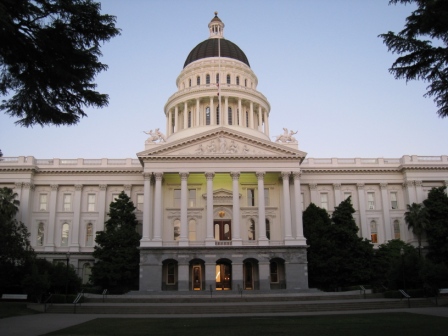 |
| State Building |
 |
| The Peace Garden, full of roses and writings from children about peace |
Tuesday Day 2
About face. The sessions today were AWESOME. Lots of new concepts I could directly apply to current work: better ways to map requirements to user design; faceted navigation to assemble documentation pieces into content that is applicable for the situation; ways to start planning content strategy; better ways to estimate projects work.
Beyond that, there were thought stretching times. At a meeting for one of my SIGs (Information Design & Architecture), we had a heated discussion about the difference between the architecture of information, content strategy, and visual design, and how they relate to one another. Another session where Michael Priestly (godfather of DITA; he actually presented DITA at our chapter meeting about 4 years ago, waaaay before any publishing tool supported it) demonstrated their new, open source, online content delivery system.
There were also ideas that I could take back to others at my company: for the S&M team (that's Sales & Marketing in case you're getting any ideas about my workplace), ways to manage content and analyze our website; for my team's Product Manager, ways to identify and prioritize real user goals (not just the ones we dream up).
Wednesday Day 3
Where'd the time go? The last day went by in a blur of sessions. Learned to duck out of ones that just didn't live up to their descriptions or were too general for my liking. Some speakers are insightful enough you just go see them, even though the topic seems like it has nothing to do with your work. Sometimes there would be three sessions I was interested in running simultaneously, so I'd have to make a tough choice. But with summit registration, you now get access to all recorded sessions (speaker audio and screen capture), so there's a way to catch the ones you missed. I'm also super excited about sharing the best sessions with my team mates back home. Maybe we'll listen to one a week over lunch, and talk about the ideas it presents and the changes we can make as a team.
Spent more time talking to people, between sessions, finding how they handled the topics we had just listened to (or were about to listen to) at their companies where they were stuck, where they had made a change, what kind of transition they were in, how their work environment differed from mine. Yeah, I know you're supposed to network for personal career development, but really it felt more like finding someone with a common interest or hobby, and getting right into it with them. It's like a club with a secret handshake. Where's the best fishing hole? The best place to buy lures? The biggest fish you caught? What technique did you use? The tacit understanding of what it takes to go out for hours and sit in a boat, to produce a single edible specimen.
 |
| Convention Centre Ceiling |
Then, in a flash the Summit is all done. The last session is over, suitcases are packed and wheeled away, my mind is full of ideas and innovation. On the long flight home to reality, I pondered what things I can try to implement right away, and what will just percolate in the back in my mind until an opportunity arises. At work, I've bored all the non-writers with details of the DITA methodology, and peaked some interest in distributing our documentation more dynamically through our website. Maybe I can get something to change after all!


