Sunday, November 20, 2011

Pub Night at The Firkin

Untitled Document by Fei Min Lorente, President

Who says technical communication is boring? The Southwestern Ontario Chapter got the year off to a fantastic start by meeting at The Firkin during Okoberfest. Completely informal, the attendees were free to talk about business, or not. Most of the council was there, so it was a great opportunity to meet the people who are planning your events and spending your money.

Welcome to the new recruits who came out that evening and volunteered to help the chapter:
  • Ann Garniss will be helping with Education Days, which are our annual workshops.
  • Sian Waterfield will be helping with competitions.
  • Dwight Baer will be helping with the Heidi Thiessen Memorial Award (the student award competition).
We had an enthusiastic response to this social get-together, and we'll plan more of these in the future. Thanks to Rob Cundari who had this great idea and who did the organizing.
Isn't that interesting? President Fei Min Lorente listens
intently to the conversation over chicken fingers and fries.


I can visualize all kinds of things while I'm wearing this hat.
Jim Bousquet, Treasurer


Everyone's happy during Oktoberfest, especially with a drink and that hat.
Veronica Kutt from Front Runner Training and Rob Cundari, Vice-President.


These nachos require serious consideration.
(left to right) Ann Garniss, Education Manager assistant;
Ilmar Kutt, Front Runner Training, and Debbie Kerr, Past President


What do you really think about the virtues of Irish stout vs. a winter porter?
Sian Waterfield, Competitions Manager assistant, and Nancy Halverson, Competition Manager

Monday, August 29, 2011

Digital Futures: Technical Communication in the Digital Age

by Fei Min Lorente, President

Ken Coates, Dean of Arts at the University of Waterloo, was the guest speaker at the 2011 Annual General Meeting for the Southwestern Ontario Chapter of the STC. He discussed technical communication’s future in the digital age – where are we headed, and how will we fit with the new trends.
The effects of the Internet on worldwide communication have been hard to predict, but several decades after its inception, we’ve observed a deleterious effect on reading and writing. We spend more time skimming a search engine's results or a web page than actually reading. When we do read a web page, we find it usually provides a superficial treatment of the subject because writers know that it’s hard to read a lengthy article online (often on a small screen like a smart phone), and readers have low expectations. Lack of publishing rigour leads to incorrect grammar and articles that are typically written for a grade five level.

Most of the writing done now is in the form of emails, text messages, or tweets. Even university level exams are moving away from essays and long answers and moving towards multiple choice because they are machine readable.  Between the reduction of book reading and the rise of writing for the Internet, writing skills are in decline.
In the meantime, the fastest growing economies are in non-English speaking countries, such as China, India, South Korea, and Germany. Israel, South Korea, Taiwan, Japan and Finland lead the way in digital media. They are learning English as a matter of course; as a result, they can harvest information from the English websites. About 350 million people in China are learning English, while very few North Americans or Europeans are learning Mandarin or Japanese. These countries are rapidly gaining a huge advantage over North America.

Emerging countries have embraced the digital revolution on a scale that is hard for us to imagine. The University of Waterloo started a digital media campus in Stratford this year. The masters program can accommodate up to 20 students. Compare with China—they built a digital media campus that can accommodate 425 000 students. The digital economy has shifted to Asia.
Asian students have to compete for the relatively few spots available in universities. In the international workplace their graduates have many advantages over ours: multilingual ability, better work ethic, competitiveness. One advantage we still have is that the English that they are learning is not very good.

Our educational institutions are part of the problem. Schools require less book reading and expect more Internet research. As a result, students get used to finding simplistic information about a subject. Furthermore, schools provide little instruction on basic writing skills, and few opportunities to learn and become proficient in a second language. Students with short attention spans are accommodated by the curriculum.
As a consequence of the digital age, the audience that technical communicators are writing for has changed. Readers expect to find information faster, and when they do find it, they expect it to be simple and easy to understand. With the global economy, our readers are a more multicultural group. Many readers understand English as a second language, and might be reluctant to ask questions when they don't understand something.

Digital media will continue to grow at a rapid pace, and as technology matures, the majority of workers in the field will shift from technology makers to technology users. We can already see that content is growing in importance. This enables communicators like us to find new career opportunities. See Michael J. Totten’s blog (http://pajamasmedia.com/michaeltotten/) for an example of some of the best freelance journalism, and he doesn’t have to sell anything to a media company. He makes enough money from his blog to travel to the areas that he is reporting about.

Dean Coates' advice to us was to learn another language if you have the chance. Instant translation is still at least 25 years away. If you can’t learn another language, at least try to understand other cultures so that you can write for a global audience. Our ability to write properly and organize material to explain a complex technology will be a rare talent in the future. It will be up to us to maintain the art and science of good communication.

He recommended reading Physics of the Future: How Science Will Shape Human Destiny and Our Daily Lives by the Year 2100 by Michio Kaku. This book will give you an inkling of the social ramifications of communication in a digital age.
Shortly after Dean Coates’ presentation, I came across two other related items of interest:

·        See guest post on Tom Johnson’s Idratherbewriting blog, http://idratherbewriting.com/2011/06/15/technical-writing-in-china/ about “Technical Writing in China” by Ivan Walsh

·        Listen to the interview on Spark, a CBC program hosted by Nora Young. Author Cyrus Farivar talks about his book The Internet of Elsewhere: http://www.cbc.ca/spark/2011/06/full-interview-cyrus-farivar-on-the-internet-of-elsewhere/. It examines the internet experience in four very diverse societies: Iran, Senegal, Estonia and South Korea.
Dean Coates’ presentation and these other sources are signs that we have to start looking beyond our own language and culture to see the future of digital communication.

Monday, July 4, 2011

Southwestern Ontario Chapter Second Annual General Meeting

by Carol Lawless, Secretary

Another year wrapped up and while we didn’t pop the champagne or launch into Auld Lang Syne, we did have good friends, old and new, and good cheer. The Huether Hotel’s Boardroom was the scene of our second Annual General Meeting (AGM) on June 12, 2011. We welcomed Ken Coates, our guest speaker who is the Dean of Arts from the University of Waterloo, enjoyed a good meal and participated in some excellent networking conversations. And of course, conducted the official business that’s crucial to any non-profit organization.

The evening’s sponsor was Technically Write Consulting Ltd. Thank you for paying the balance of our food and drink bill!

Our outgoing President, Fei Min Lorente, recapped the year. We had a successful ten months with our core offerings (education evenings, webinars, workshops and competitions). But we also had an innovative year. We:
  • offered several education evenings by webinar. For our members who live too far to drive in for an evening, this offers a chance to be involved in the chapter.
  • opened our student award competition to all post secondary schools in Ontario.
  • hit social networking, using LinkedIn and Twitter as well as the new STC website to move towards two-way communications.
  • introduced the participation contest.
  • leveraged our partnership with Communitech.

Looking ahead to the future, we need to provide a venue where members and non-members are more excited to participate. To that end, we will be doing a survey later this summer to find out what you think we need for a vibrant chapter and what would fulfill your needs. Some ideas we floated informally were more relaxed networking evenings, pub-style, to complement our education evenings.

Our chapter is working with other Canadian and International chapters to support one another with ideas and resources. The Canadian chapters, specifically, are working on a Canadian salary survey and are looking to revive the Canadian Issues SIG.

For the official business we had a quorum – enough members were present to vote and elect the board of directors for 2011-2012. We began by reading and approving the 2010 minutes. Treasurer, Jim Bousquet presented a view of the audited financial statement for 2010. All members are entitled to see the financial statement, which they can obtain from the treasurer. The members accepted the report unanimously and also agree to retain the auditors for the 2011 statements.

The election of officers yielded the following results (all were elected unanimously):

• President: Fei Min Lorente

• Treasurer: Jim Bousquet

• Secretary: Carol Lawless

While the president can (under our bylaws) serve for a maximum of two consecutive terms, she may run for a third term at the request of the membership. Since there were no other nominations put forward for President, Fei Min graciously agreed to stay for a third year. Rob Cundari was appointed as Vice-president. We wish him well as he learns the ropes! Thanks to both of you for stepping up to keep our chapter alive and vibrant.

Fei Min presented several awards – She announced the participation contest winners:

• third place (150 points): Carrie Warner won $50

• second place (150 points): Ursula McCloy won $100

• first place (200 points): Tricia Ward won $250


Jim presents a cheque to Ursula, the happy second place winner in the Participation Contest


Jim presents a cheque to Tricia, the happy first place winner in the Participation Contest


Debbie Kerr receiving her award from Fei Min Lorente
Debbie Kerr officially received her Distinguished Chapter Service Award. Debbie was unable to attend the March awards night to receive this well deserved recognition for her huge contributions to the chapter. We were delighted that she could receive it at the AGM.

And finally Fei Min thanked the council members for their dedication this year:

Absent: Gwyneth, Elaine, Patrice, Tracey, Heather, Sam

Sylvia - liaison with Fanshawe College and University of Western Ontario, and liaison with London Word Fest in 2012

Ursula - Employment Manager

Nancy - Competitions Manager and Hospitality Manager

Rob -Membership Manager

Debbie - Past President and jack of all trades

Jim - Treasurer

Carol - Secretary

Fei Min - President

And finally, a special thank you to all our families for their support and understanding.

Our chapter is run by volunteers and we are always looking for new faces around the table. Your input and help are essential for an energetic and exciting chapter. Volunteering is a great way to build your portfolio, learn new skills, and impress people. If you’re interested, we’d love to have you on board! Specifically we’re looking for people to fill the roles of webmaster and education manager.

We are taking a break from events for the summer, but we look forward to seeing you again in September. In the meantime, stay in touch. There are so many ways...

Thursday, June 23, 2011

Awards Night 2011

Why read about it when you can watch it? Here's the video, thanks to ExpoTube, our partner in communication.


If you want to know how you can become an award-winner, see the requirements on our website for the awards that were handed out that night:
Maybe you'll be in the picture next year!

Thursday, June 2, 2011

Reaching the STC Summit (Part Two)


By Ursula McCloy
Main Entrance to the Convention Centre
Monday -- Day 1
Sessions started on Monday, and I have to say I was disappointed. I musta picked the wrong topics or something, but they were all so general I couldn't find anything useful to take away. Everyone was going on about DITA, single sourcing, social media, Web 2.0, and Agile development. Well. If you don't happen to be able to completely re-invent your work environment, most of that is useless. I write SDK documentation for a niche market. There ain't no hashtag for it, and I don't think there ever should be. There is no point in single sourcing something that only gets used in one place anyways. And there's no way you can write a cute little task topic for the hairy situations our customers use our software for.

Entrance to the Vendor Showcase
But I loved the vendor showcase. I'm in the market for a new help authoring tool, and have been pondering the best option for over a year. This was my opportunity to corner their reps and ask all the questions that are relevant to me. And they listen! Little ol' me who only needs to buy three licenses -- they listen to what I'm saying as if I was outfitting a team of hundreds! I've got two private discussions lined up for when I get back, to see how two different pieces of software can be used in a new workflow.

End of day wrapped up with a get-together at a pub, with a strong Canadian presence and a younger (ahem) demographic. The pub had 14 kinds of their home-brew on tap, which made it an excellent opportunity to network. Nuff said :). I've never been to Sacramento either, so I really enjoyed the downtown core where the conference was located - a blend of old & new architecture, civic art, beautiful gardens, restaurants, pedestrian ways, and so on. I wonder if all the STC summits are so happily situated?


Tribute to the Pony Express in Old Sacramento

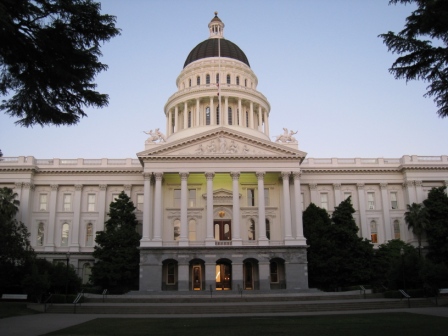
State Building

The Peace Garden, full of roses and writings from children about peace
Tuesday Day 2
About face. The sessions today were AWESOME. Lots of new concepts I could directly apply to current work: better ways to map requirements to user design; faceted navigation to assemble documentation pieces into content that is applicable for the situation; ways to start planning content strategy; better ways to estimate projects work.

Beyond that, there were thought stretching times. At a meeting for one of my SIGs (Information Design & Architecture), we had a heated discussion about the difference between the architecture of information, content strategy, and visual design, and how they relate to one another. Another session where Michael Priestly (godfather of DITA; he actually presented DITA at our chapter meeting about 4 years ago, waaaay before any publishing tool supported it) demonstrated their new, open source, online content delivery system.

There were also ideas that I could take back to others at my company: for the S&M team (that's Sales & Marketing in case you're getting any ideas about my workplace), ways to manage content and analyze our website; for my team's Product Manager, ways to identify and prioritize real user goals (not just the ones we dream up).

Wednesday Day 3
Where'd the time go? The last day went by in a blur of sessions. Learned to duck out of ones that just didn't live up to their descriptions or were too general for my liking. Some speakers are insightful enough you just go see them, even though the topic seems like it has nothing to do with your work. Sometimes there would be three sessions I was interested in running simultaneously, so I'd have to make a tough choice. But with summit registration, you now get access to all recorded sessions (speaker audio and screen capture), so there's a way to catch the ones you missed. I'm also super excited about sharing the best sessions with my team mates back home. Maybe we'll listen to one a week over lunch, and talk about the ideas it presents and the changes we can make as a team.

Spent more time talking to people, between sessions, finding how they handled the topics we had just listened to (or were about to listen to) at their companies where they were stuck, where they had made a change, what kind of transition they were in, how their work environment differed from mine. Yeah, I know you're supposed to network for personal career development, but really it felt more like finding someone with a common interest or hobby, and getting right into it with them. It's like a club with a secret handshake. Where's the best fishing hole? The best place to buy lures? The biggest fish you caught? What technique did you use? The tacit understanding of what it takes to go out for hours and sit in a boat, to produce a single edible specimen.

Convention Centre Ceiling
Then, in a flash the Summit is all done. The last session is over, suitcases are packed and wheeled away, my mind is full of ideas and innovation. On the long flight home to reality, I pondered what things I can try to implement right away, and what will just percolate in the back in my mind until an opportunity arises. At work, I've bored all the non-writers with details of the DITA methodology, and peaked some interest in distributing our documentation more dynamically through our website. Maybe I can get something to change after all!

Reaching the STC Summit (Part One)


By Ursula McCloy

It's strange being a newbie again. I've been a tech writer and an STC member for over 13 years (or is it 14?), and normally I feel a bit weathered around the edges. But I've never made it to a summit, so it was a brand new experience for me. I've been wondering for a few years - why, oh why, did I not go in '97 when it was in Toronto? So I was pretty excited to get the opportunity to attend: hoping to learn a bit, network with the people who I know by name but not in person, and spend a few nights in a quiet hotel room, sans enfants.

Sunday - Day 0

Leadership Day isn't strictly part of the education portion of the summit. Instead, it's time for the community leaders (SIGs, chapters, special committees) to talk STC shop: what the society is doing, what it's changing, what it's looking for feedback on. After the requisite intros, awards, and thank-yous (yawn), we got right down to work. The burning question this year is what can STC do to serve its communities and individual members better? What do people want from the STC?

The day was a series of progressions, so I picked some of the topics that seemed most relevant for our chapter.

  • Competition: Discussed how they're improving the evaluation forms. Last year, they threw away the old checklists, since what people find most valuable are the actual reviewer comments. But they are hoping to improve the forms this year so they're less work for the reviewers to fill out. Wonder if that will mean less review comments in general?
  • Virtual marketing of your community: I'm suspicious of stuff like this, since I don't have time to moon about on Facebook and tweet about what I had for lunch. But the main point was whatever method you use to communicate with your members, make a plan for the year, stick to it, and be consistent. So whether your channel is a newsletter, a Facebook page, or a mailing list, you've got to know when you need to communicate something, communicate it at the same time, and in the same way. You need to make message consumption simpler by making it as easy to digest as possible.
  • Problems/successes faced by geographic communities: Lack of participation in chapter events concerns everyone, particularly when members are polled and say that is what they value. What to do about decreasing attendance? Virtual seminars (either entirely remote, or live webcasts of an actual meeting), moving locations, planned communication about events are ways to encourage people to come out. Or just do stuff together. Like go to movies, hikes, baseball games, the pub. There is a general feel that we need to re-establish the community aspect of a chapter.
  • How can we recruit, support, and maintain volunteers in a virtual environment? Bodily presence at events isn't always possible, so how can we harness people to help out remotely, and how do we outline terms of engagement? For example, what is an appropriate time period for people to respond to an email, before they've missed the window of opportunity? Answer: 1 business day or less. I think that's pretty true for work too.


Leaders and Attendees Mixing It Up at the Community Reception

Finally, we wrapped up with a demo and Q&A session about the MySTC networking site its features, the planned enhancements, and so on. I think it's neat that our local chapter can have its own group; maybe we can have a forum where we can ask for advice, voice opinions, and get to connect with people in our own area? So scratch my above comment about mooning about on Facebook -- I've already signed up, connected with a bunch of people I met at the conference, and am looking forward to some collaborative inspiration.

Friday, May 13, 2011

The My STC Network is Open for Business!

Today we launched the My STC Network on STC.org.

This new feature will change the way technical communicators interact online. Combining the knowledge-sharing capabilities of a professional network with the interactivity and user experience of a social network, My STC is an important platform for networking, collaboration, communication, community management, and more.

We’ve worked hard to ensure that the interface is simple enough to be intuitive while still incorporating the tools and resources that will provide the greatest value possible. We’ve involved community leaders from STC chapters and SIGs in our pre-release site testing, and their feedback has helped shape our efforts in refining the interface and determining which features are top priorities for STC members.

To experience the My STC Network, please visit www.stc.org. (Because of DNS propagation, it may take some time before you see the updated site. This depends on your ISP. However, over the next few hours, the site new site should be available to all users.)

To log in, just enter your existing STC username and password. You can do this by clicking on the “Site Access” link at the top right-hand side of the page or by clicking on the “My STC” tab on the navigation bar.
Once you’re inside, you’ll have the opportunity to personalize your user experience. You can edit your profile, add personal information, upload an image or video, create or view events, and begin participating in discussions. If you’re a member of an STC chapter or SIG, you’ll be automatically added to the corresponding discussion groups when you sign in. If you’re not a member of an STC community, you can participate in open discussion groups or start your own.

With this new platform, STC can also invite any STC.org visitor to register for the website, providing the opportunity for nonmembers to purchase education offerings, publications, and other STC services. These accounts will also allow nonmembers to gain limited access to the My STC Network, where they will be able to participate in designated nonmember groups and view or join open community groups. (A group’s status as “open” or “private” is determined by the administrator; in the case of STC communities, usually the president or manager.) If you’re considering inviting a technical communicator you know to join STC, this is a great way to get them involved.

We’ve prepared a video tutorial that explains the new features of STC.org. If you’d prefer a walkthrough before signing in or need some help finding your way around, please have a look at the following instructional video:http://youtu.be/WDo99UUhj9s.

We’ve taken great care to make this new platform as user-friendly as possible. If you should happen to encounter any problems, however, please let us know. You can leave feedback using the “Feedback” tab on every page of the site. This will take you to Get Satisfaction (separate login required), a tool we’re using to aggregate and address site issues and suggestions.

We hope you enjoy these new Web tools developed to enhance collaboration, networking, and knowledge sharing among professionals in the field of technical communication. We look forward to seeing you online.

Reprinted from STC's Notebook Feed by Kevin Cuddihy on 12 May 2011