Showing posts with label Nashifa Carter. Show all posts

Sunday, August 29, 2010

STC - SOC - First Annual General Meeting


This June we held our first Annual General Meeting at the Heuther’s Boardroom. Members and non-members were welcomed. Since only chapter members have voting privileges, the 12 members in attendance comprised quorum for the business component of the agenda. Fei Min Lorente opened the evening with a recap of our accomplishments this year. It’s an impressive list - 16 activities long. These are just the highlights!

1. Registered as a non-profit organization
2. Wrote our bylaws which were approved by head office
3. Hosted four education evenings and four web seminars
4. Ran a successful student award competition
5. Jointly held the technical publications and online competitions with the Toronto chapter
6. Held our wine and cheese awards night
7. Organized two days of workshops
8. Published the newsletter
9. Launched a Blog and events discussion list
10. Sent a council member to the International STC conference to participate in the leadership day
11. Revised the International Affiliation Agreement and sent it to head office
12. Mounted a membership renewal campaign
13. Presented the benefits of the STC to the editor’s group at RIM
14. Organized regular meetings and correspondence with the other Canadian chapter Presidents
15. Signed a limited partnership agreement with Communitech
16. Moved the website to a new host

We’ve also started planning for next year, and are investigating technology to allow our members to be more involved. The new Blog and the events list permit more timely and interactive communication. We’d like to expand this forum into a discussion area for questions and answers and increase the number of web casts and teleconferences so members who live and work at a distance can be included. We’re also working with other chapters on various issues. At the Canadian level, we’re working on a re-write of the International Affiliation Agreement and producing a Canadian Salary Survey.

Financially, our chapter is in the black. Our Treasurer, Jim Bousquet presented the audited financial statement for 2009. Details are available on request.

From the business side of the annual meeting, the members in attendance approved the bylaws unanimously. Then we held the Board of Directors elections. Fei Min Lorente continues as President, Jim Bousquet as Treasurer and Carol Lawless as Secretary.

That wrapped up the General Meeting agenda, but not the evening. Aside from enjoying a scrumptious dinner, and great company, we announced our partnership with Communitech. It’s a great opportunity for us to tap into their large local membership and Communitech now has another professional offering for their members. We also officially presented Lori Jankowski with her Distinguished Services Award.

Finally, Fei Min thanked the many volunteers who have made the year a success through their hard work. And of course, Fei Min deserves much thanks and credit for her hard work. Debbie Kerr, Past President took the floor to acknowledge everything Fei Min has done.


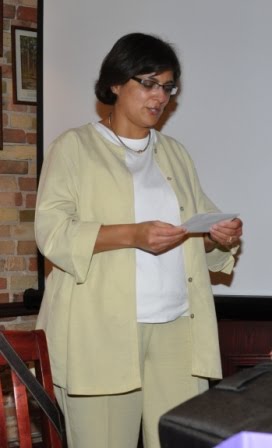
We wrapped up the evening with Wilfred Laurier University’s Nashifa Carter, who gave a very interesting and informative talk on persuasion and working with Subject Matter Experts and other colleagues. See Working effectively... for a summary of her talk.

Saturday, July 31, 2010

Annual General Meeting Guest Speaker: Nashifa Carter

Working Effectively with Subject Matter Experts


Technical communicators usually share a common contradiction between their position in an organization’s hierarchy, and the job they have to do. For the most part, they are not in positions of authority. From this powerless position, they have to get information from co-workers (SMEs and managers) who are busy with their main duties, and convince them to adhere to the documentation schedule.

In an engaging and entertaining discussion, Nashifa guided the audience through the obstacles to working with people who have a higher status than technical communicators. We discussed some of the challenges to working relationships: people have different ways of communicating, they often misunderstand each other, they sometimes don’t respect each other, and in the case of technical communicators, we are often bearing bad news, such as “This description is unintelligible” or “I found another bug”. We also talked about the best way to present bad news, which is to state the problem in a way that does not accuse the SME of doing something wrong, but puts the emphasis on difficulty we are having. We compared “you don’t make any sense” to “I don’t understand”.

Conflict between people can be caused by generational gaps. People of different ages often have different expectations and attitudes with respect to acceptable behaviour at work, what constitutes good work ethic, and how to be compensated for productivity. Different corporate cultures, or simply different cultures, can cause conflict, too, for the same reasons as generational differences. And there are still many basic gender differences that have nothing to do with equality, but everything to do with the fact that male and female brains operate differently. (At this point, Nashifa reminded the audience that our discussion of differences and their causes are sweeping generalizations, but are still useful in a broad sense because they raise awareness about the source of interpersonal differences.)

To gain the co-operation of SMEs, technical communicators might try working on their interpersonal skills. They can look at the problem from the SME’s point of view. From there, a technical communicator and SME can try to find common ground.

To gain the respect of the SMEs, technical communicators must establish credibility by demonstrating competence in the job, good work ethic, and professional behaviour. Technical communicators should make the extra effort to say “thank you”, and be confident enough to say “I’m sorry”, showing that they take responsibility for their actions. Most of all, they must form relationships with the SMEs.

As for how to form relationships, we had two different methodologies from the audience. One person uses the “bring cookies and buy them a coffee” method. She found this inexpensive form of bribery to be effective, especially when you can get information from the SME over coffee. Another attendee deliberately avoided the cookie method and chose instead to go out for a beer with the guys, and share in their jokes. In both cases, these women formed relationships with the SMEs, and gained their co-operation.

The audience left with the encouraging message that although technical communicators are often in powerless positions, they can still wield influence. Nashifa also kindly offered her contact information in case anyone has more questions or would like to discuss a particular case. You can contact her at ncarter@wlu.ca.

----------------------------------------

Nashifa has over 10 years' experience in Human Resource Management, focusing on recruitment and selection, performance management, training and development, and organizational development. Her experience encompasses both the private and the public sectors, and she has taught at Laurier’s School of Business & Economics for the past 13 years.

Her management and consulting experience includes both a strategic focus: reviewing and recommending changes to organizational systems; and a tactical focus: implementing change. Her strengths lie in training and development, downsizing and reorganization, performance management, and recruitment. She assesses needs and develops materials for management and staff training programs that she delivers on a variety of subjects, including:

• Communication and interpersonal skills

• Conflict management

• Problem solving

• Customer service

• Human Resource Management (HRM)

In addition, Nashifa has undertaken several communication projects: creating and writing training materials, HR manuals, employee handbooks, brochures and newsletters. Currently she is the Harassment/Discrimination Coordinator at WLU.