Saturday, July 31, 2010
Annual General Meeting Guest Speaker: Nashifa Carter
Technical communicators usually share a common contradiction between their position in an organization’s hierarchy, and the job they have to do. For the most part, they are not in positions of authority. From this powerless position, they have to get information from co-workers (SMEs and managers) who are busy with their main duties, and convince them to adhere to the documentation schedule.
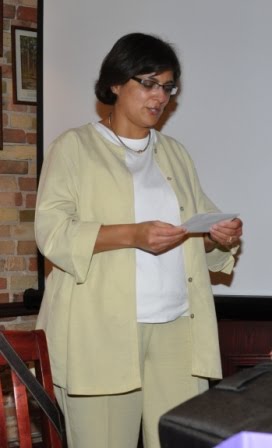
In an engaging and entertaining discussion, Nashifa guided the audience through the obstacles to working with people who have a higher status than technical communicators. We discussed some of the challenges to working relationships: people have different ways of communicating, they often misunderstand each other, they sometimes don’t respect each other, and in the case of technical communicators, we are often bearing bad news, such as “This description is unintelligible” or “I found another bug”. We also talked about the best way to present bad news, which is to state the problem in a way that does not accuse the SME of doing something wrong, but puts the emphasis on difficulty we are having. We compared “you don’t make any sense” to “I don’t understand”.
Conflict between people can be caused by generational gaps. People of different ages often have different expectations and attitudes with respect to acceptable behaviour at work, what constitutes good work ethic, and how to be compensated for productivity. Different corporate cultures, or simply different cultures, can cause conflict, too, for the same reasons as generational differences. And there are still many basic gender differences that have nothing to do with equality, but everything to do with the fact that male and female brains operate differently. (At this point, Nashifa reminded the audience that our discussion of differences and their causes are sweeping generalizations, but are still useful in a broad sense because they raise awareness about the source of interpersonal differences.)
To gain the co-operation of SMEs, technical communicators might try working on their interpersonal skills. They can look at the problem from the SME’s point of view. From there, a technical communicator and SME can try to find common ground.
To gain the respect of the SMEs, technical communicators must establish credibility by demonstrating competence in the job, good work ethic, and professional behaviour. Technical communicators should make the extra effort to say “thank you”, and be confident enough to say “I’m sorry”, showing that they take responsibility for their actions. Most of all, they must form relationships with the SMEs.
As for how to form relationships, we had two different methodologies from the audience. One person uses the “bring cookies and buy them a coffee” method. She found this inexpensive form of bribery to be effective, especially when you can get information from the SME over coffee. Another attendee deliberately avoided the cookie method and chose instead to go out for a beer with the guys, and share in their jokes. In both cases, these women formed relationships with the SMEs, and gained their co-operation.
The audience left with the encouraging message that although technical communicators are often in powerless positions, they can still wield influence. Nashifa also kindly offered her contact information in case anyone has more questions or would like to discuss a particular case. You can contact her at ncarter@wlu.ca.
----------------------------------------
Nashifa has over 10 years' experience in Human Resource Management, focusing on recruitment and selection, performance management, training and development, and organizational development. Her experience encompasses both the private and the public sectors, and she has taught at Laurier’s School of Business & Economics for the past 13 years.
Her management and consulting experience includes both a strategic focus: reviewing and recommending changes to organizational systems; and a tactical focus: implementing change. Her strengths lie in training and development, downsizing and reorganization, performance management, and recruitment. She assesses needs and develops materials for management and staff training programs that she delivers on a variety of subjects, including:
• Communication and interpersonal skills
• Conflict management
• Problem solving
• Customer service
• Human Resource Management (HRM)
In addition, Nashifa has undertaken several communication projects: creating and writing training materials, HR manuals, employee handbooks, brochures and newsletters. Currently she is the Harassment/Discrimination Coordinator at WLU.
Tuesday, June 15, 2010
Education Days 2010
We learned to write in topics instead of documents. A topic is a self-contained piece of information about a subject. If it is self-contained, it can be re-used or put in a different order. It encourages minimalistic writing, forces writers to organize their writing, and allows many different writers to contribute to a “document” without overwriting each others’ work. If your target documentation format uses an online help paradigm instead of a book paradigm, it’s much easier to think and write in topics.
We learned to develop a structure and use it consistently. Structure provides standard sectional, syntactic and stylistic rules. The structure can be unenforced and simply defined in a template or style guide, or you can enforce structure using various tools such as XML (eXtensible Markup Language).
We learned how to plan and manage the project of implementing topic-based writing and structured authoring, such as becoming aware of the company’s goals and promoting how this project can contribute to those goals. Neil was especially helpful with tips on dealing with the political situations that can develop between departments when implementing such a project.
We learned that the answer to all questions begins with “It depends…”
As he taught, Neil illustrated his points with stories from his extensive consulting experience. For example, sometimes he recommended the same conclusions that the employees reached, but since he’s a consultant, management listened to him. If you’re having trouble convincing management to do something, a consultant can be helpful in this regard. Sometimes he’s called in to review two competing proposals and choose one. If you’re looking for the best way forward, a consultant can provide an objective, knowledgeable opinion, but you don’t have to hire a consultant to do all the work.
In the afternoon, we did some hands-on exercises with our own work samples. We practiced looking at common elements, identifying the topic type, and creating an appropriate structure that would encompass all instances of this topic type. It was an interesting exercise to apply all the theories from the morning to actual documents.
After all Neil’s hard work, we took him out for dinner at Hog Tails BarBQue to satisfy Neil’s other professional interest…. See Neil’s blog for a restaurant review. You’ll have to scroll down to find Hog Tails.
DITA from legacy to the future – Bernard Aschwanden
Building on Neil’s information about topic-based authoring and structured writing, Bernard taught us about DITA (Darwin Information Typing Architecture). DITA is a standardized XML (eXtensible Markup Language), so it enforces structure and uses the topic paradigm. Since DITA is a standard, all the tools that support DITA can exchange information seamlessly. At the end of the hands-on section, Bernard proved this to us by taking topics we wrote in FrameMaker or XMetal, and opened all of them in both tools.
Besides learning about the components and composition of DITA, we learned how to convert legacy documentation to DITA. We heard about the cost, procedures for reviewing existing documentation, a conversion plan, mapping existing documentation to the DITA paradigm, and available tools. Since the information that is written in DITA is independent of formatting, you define the format using whichever scheme or tool you choose. For instance, you might choose a Cascading Style Sheet (CSS) if your output is HTML, or FrameMaker if your output is PDF.
Armed with basic information about the most commonly used DITA elements, we wrote a topic in either FrameMaker 9 or XMetal 6. Besides putting the DITA information into practice, most of us had the opportunity to try out a new tool or a new version. I found that writing to comply with the DITA structure requires a different way of thinking because each unit of information is compartmentalized into a predefined bucket. You begin by deciding whether you are writing a concept, task or reference concept; the order and structure of the rest of your writing is then determined by that decision. This is the nature of adhering to a standard, which brings about the benefits of content re-use and tool independence.
DITA is a large and comprehensive standard. Bernard did an excellent job of providing us with the maximum information possible in a short amount of time. The hands-on exercises helped us to grasp the concepts and put them into practice, and gave us a taste of the challenges involved. The final demonstration where he took the topics we all wrote and displayed them in two different proprietary tools, with no conversion or reformatting, showed us some of the possible benefits if we were to take on the challenge of using DITA. Love it or hate it, DITA is a fascinating construct.
Education Days 2011
If you feel like you missed something, you did! Hope you can join us next year.
We’re already thinking about Education Days 2011 and we’re open to suggestions. Please get in touch with Tracey Aitcheson if you have a topic or a speaker who you’d like to hear.
Tuesday, June 8, 2010
Canadian Chapters Meeting #4
Five of the six Canadian STC chapter presidents met in April by teleconference, and we discussed the following ideas.
Electing a Canadian Director
The directors who won in the 2010 election each garnered from 306 to 457 votes. Considering this, we think we could elect a Canadian director with just over 300 votes. Bernard Aschwanden from the Toronto chapter intends to run for a director position next year. STC policy states that chapters cannot endorse a candidate, but we can certainly help to publicize the candidacy of a Canadian. We can’t expect a single Canadian director to change the entire STC organization, and every director has a duty to the entire organization, not just one country, but a Canadian director can advocate for issues affecting members outside of the USA, and facilitate communication between the Canadian chapters and the Board of Directors. The Canadian chapter presidents agreed to continue working together to facilitate this two-way communication.
Salary Survey
The national salary survey has been drafted, but we are debating who should participate in the survey. On one hand, the survey results are a significant benefit, and we would like to restrict it to STC members. On the other hand, if we include non-members, we will obtain a better statistical sample. However, concerns have been raised about the accuracy of the survey if we cannot be sure that the participants are technical communicators. One possibility is that we send the survey to employers and clients in addition to members. Discussions are ongoing, but we feel we can meet the intended schedule of an October distribution for December results.Insurance Proposal
Canada West Coast chapter is spearheading the investigation into health insurance for independent contractors and consultants because many of the STC members work in this capacity. The CWC chapter has found several alternatives, and are developing a survey to find out which option their members prefer. The other Canadian chapters are welcome to re-use the survey and offer the same insurance coverage as a chapter-member benefit.Proposed National Organization
A senior STC member and STC Fellow, Geoff Hart, has proposed the idea of creating a Canadian umbrella organization. This organization would collect STC dues and give a portion of them directly to the Canadian chapters (thus avoiding currency conversion fees), send the rest of the money to Head Office (so it’s only converted once), centralize the international affiliation agreement, and co-ordinate communication and joint efforts between the provinces. We had some concerns about the availability of volunteers to work in a national organization, and whether it would be cost-effective. A business plan is required; however Geoff is unable to commit his time to develop one. Is anyone else interested in pursuing this? If so, please contact your chapter president.Usefulness of Canadian Chapter Meetings
The Canadian chapter presidents agreed that these conference call meetings have been helpful to all participants, and we intend to continue having them on an as-needed basis. We also took the opportunity to compare membership numbers. Most chapters have experienced a 50% drop in membership and are taking steps to attract more members and encourage people to renew. Both the Toronto and Alberta chapters are exceptions to the membership decline; Alberta even won the STC renewal race for chapters of 150 to 300 members! Congratulations, Alberta!Several chapters introduced their incoming presidents who will participate in meetings after June 2010.
As always, if you have any concerns, questions or suggestions, please discuss them with your chapter president.
Friday, May 14, 2010
A Monumental Day Dawns for Technical Communicators: Certification!
The Society for Technical Communication (STC) announced today that certification for the technical communication field has been approved. Within the next year, technical communicators will be able to attain certification in their profession.
Certification creates two enormous benefits for our profession and for practitioners. First, certification establishes a solid foundation for the legitimacy and economic contribution of technical communication. Second, certified practitioners can clearly demonstrate their expertise as technical communicators, greatly enhancing their value in the marketplace.
Practitioners will become certified in six core competency areas:
• User analysis
• Document design
• Project management
• Authoring (content creation)
• Delivery
• Quality assurance
As a result, employers and clients alike will now have a concrete idea of the expertise, contribution, and value that technical communicators bring to the marketplace. STC is developing a page on its website dedicated to promoting certification and explaining the value of certified technical communicators.
Two days ago, on 30 April, the STC Board of Directors accepted a business case from its Certification Task Force. This historic event occurred after 35 years of ongoing and difficult discussion. The Society has embraced the idea of certification for technical communicators, and in the coming months will be developing a certification program.
Certification will be based on assessing portfolios and work artifacts, not examinations. (In other words, there are no tests.) This method takes advantage of the existing methodology and infrastructure of both the publications competitions and the Associate Fellow and Fellow process. To implement the program, STC is defining assessment criteria for each of these six competency areas, then recruiting a network of examiners to review applications. In the future, as the Body of Knowledge is fleshed out, STC will look at adding an exam-based assessment as another certification method.
Once conferred, certification will be valid for three years. To ensure that competencies are kept relevant, certified professionals must become recertified for another three years. As with many other professions, recertification involves completing and participating in educational and professional activities. STC currently has a number of these opportunities available, and will be creating more in the upcoming year.
Member and nonmember certification and recertification fess are still being developed; however, these fees will be comparable to certification programs of similar associations.
To learn more, attend the “Status of Certification for Technical Communicators” session Wednesday morning, 5 May, at 11:30 AM in Cumberland KL during STC’s Summit in Dallas, Texas. The Certification Task Force will report on its process, progress, and future. You can also expect to hear much more about certification in the coming weeks!
Saturday, May 8, 2010
STC Summit - Topic Trends
Prior to coming to the conference, I tried to plan which education sessions I wanted to attend. Since I was going to a conference for technical communicator, nearly every session seemed to apply to me. I took my best guess at what I thought would be the best for me. However, once I got to Dallas and started looking again, I started to develop stronger feelings about some sessions over others. The name of the speaker made the difference. In other cases, I noticed something in the session descriptions that I hadn't notice it before. It was like being told you could only have one piece of candy when all of them looked good. With this in mind, I spent every night reviewing the next day's sessions to make sure that what I thought were my best selections before I arrived at the Summit were still my best choices.
When I was planning for the conference, Fei Min Lorente (your fearless president) and Carol Lawless (your chapter secretary) suggested that I select two sessions for each time slot so that if one session wasn't providing me with the information that I wanted I could go to my second choice. I am happy to report, in all cases, that I was satisfied with my first choice.
On May 3, I attended the following sessions:
- Assessing Your Corporate Value - Jack Molisani
- Using Stories for More Effective Usability - Whitney Quesenbery
- Content Management as a Practice - Pamela Kostur (my favourite for the day)
On May 4, I attended the following sessions:
- How to Edit Online Like a Pro! - Linda Oestreich and Michelle Corbin
- Creating Visual Help and Training Using Adobe Acrobat - Neil Perlin
- Managing Documentation Projects in a Collaborative World - Larry Kunz (one of my favourites for the day)
- Content Strategy SIG Progression - too many presenters to mention
- Building Visual Explanations: Practical Advice for Writers - Don Moyer (my favourite of the Summit)
On May 5, I attended the following sessions:
- Results of Interviewing Editors: Best Practices, Challenges, Insights - Angela Eaton, Liz Pohland, Cynthia McPherson
- Thriving in an Agile Environment - Kathryn Poe
- Enhance Your Writing Career with Improved Speaking Skills - Barrie Byron
While the topics may seemed varied, there were two hot topics for the Summit: Content Strategy and Agile. Some of these topics you can see in the title of the sessions and others were embedded in the topic descriptions.
Social Media
With changes in the way that information can be presented to users, a content strategy is becoming more accurate than preparing a documentation plan. With the various social media options available (e.g. forums, wikis, Twitter, and blogs), many organizations are looking toward using these resources in addition to traditional documentation. In some cases, these other methods of communication will replace all or some of the more traditional methods. For this reason, the method for planning how to provide users with information must be an entire content strategy, and not merely focused on documentation.
For example, in one education session, the presenter talked about how someone had used Twitter to learn when users were having trouble with a product. Since the success of a company is often based on customer service, being proactive in providing information is an excellent place to start. Imagine being on Twitter and complaining to someone that a particular feature doesn't work. Wouldn't be great if someone from that company contacted you and provided you with an answer without you even having to contact them? In many cases, users don't even ask for assistance from the company. They often complain about the company/product without trying to get an answer to their questions. Using Twitter helps to eliminate this step.
Another interesting way to use Twitter is to get sales leads and to obtain feedback about what features users would like to see in a product. Another way that companies are using social media is to use wikis for Help and forums for customers to obtain support from either the company or fellow users. Social media seems to have more uses than just being sociable.
Agile
Agile is a new way of planning and completing a project. This methodology replaces the traditional waterfall and iterative waterfall that is usually used for the software development life cycle. With Agile, requirements, development, documentation, and testing, take place over and over in iterations that build on the previous iteration. One iteration might include A, B, and C. The second iteration will include any necessary changes to A, B, and C, and new items D and E. This process will continue until everything is complete -- development, documentation, and testing.
The major change for technical communicators is that everyone involved in the design and development cycles are part of the project right from the beginning. This means moving from the end of the development cycle to being involved right from the beginning. As you can imagine, for many technical communicators, this is a big and welcome change.
Some people enter into the Agile world for the wrong reasons, for example, they believe that it will eliminate the need for documentation and that everything will get done faster. The truth is that documentation will still be needed; it just might be created using different timelines, which will necessitate writing and reviewing documentation in a different way. As for getting work done faster, this will only be true if the people involved in the process have the discipline needed to complete their work on time and in the way that is needed. Without this discipline, companies can end up with more chaos than they may have had before.
Conclusion
It seems like there is a lot of potential changes to the role of technical communicator. It also emphasizes that the term technical writer does not accurately reflect our changing role.
Thursday, May 6, 2010
STC Summit - Tourist Tidbits
Tuesday, May 4, 2010
The Summit 2010, Keynote Speaker and Education Sessions Begin
For most of the conference attendees, this was the day when the bulk of us started learning. The Leadership Day enabled me to learn from one perspective, the remaining days were opportunities for me to learn from another perspective.
The first stage of learning was from the keynote speaker. Erin McKean—Chief Consulting Editor, American Dictionaries for Oxford University Press, as well as founder and CEO of Wordnik —showed us how words, especially when considered as part of the history of the dictionary, are as much fun as we expected. She talked about the first issue of the dictionary and how there were instructions on how to look up things in alphabetical order. There was even a description of what alphabetical meant! To top this off, it was written in an older form of English (looketh up writing from the 1600s and you will knoweth what I mean). :-)
She poked fun at the dictionary itself because it describes a dictionary has having one-sentence descriptions of words that are captured in a book. If you have ever looked at a dictionary, you know that there is far more content than one sentence and it no longer needs to be in a book.
She also talked about dictionaries defining what without capturing, who, how, where and when. Her example was the word "tuxedo". Without context, how would you know if the person wearing the tuxedo was a waiter or James Bond? To give you an example of Erin's sense of humour, this was conveyed with pictures of Lego figures, where only one was carrying a gun and an attache case.
She also gave an example of a definition of a feather that went on for about five lines, which left us more confused than ever before. Talk about poor choices of words and the passive voice!
All in all, the topic struck a chord with the audience, and it became quite clear why she had just been made an Honorary Fellow of the Society.
After the keynote speaker, the more intense learning began. Because of the keynote speaker, the education sessions did not start until 1:30 pm, but they continued throughout the day until 6:15 pm. During that time I attended the following sessions (each of which is about 1.5 hours long):
- Assessing/Increasing Your Corporate Value
- Using Stories for More Effective Usability
- Content Management as a Practice
The last session hit home with me because it related to some projects that I have been working on lately. It emphasized the importance of putting processes in place even before selecting a tool, and even deciding if a tool is needed. Ironically, the speaker is from Toronto. It was particularly funny (for me) when she mentioned Canada's win over the U.S. team in the Olympics. Things went uphill after that. :-)
After these learning sessions, I attended a Community Reception. It's at events like this that you get a good sense of just how international the organization is. As a member in your own town or city, you don't really think about India, France, Israel, Australia or even the vastness of the United States, and just how many states there really are. After a short time at a networking event—not to mention Leadership Day, and talking to the person beside you at one of the education sessions—you have a real eye-opening experience. You start to recognize the vastness of the technical communication profession, of which you are an important part.
I am writing this blog entry between learning sessions, which is when I am supposed to be eating; however, to get free Internet access, which is set up in the Exhibitition Hall, I have to use the terminals a little off hours, although, as you can see from the picture, there really is no down time.
My head is getting ready to burst with all the new information. It helps to write about it and share it with others. Stayed tuned for more details about some great sessions that I have attended so far today.


